Cooling vests with ice packs
The pocket-style cooling vest: a work vest with sealed pockets that hold frozen ice packs against the chest, back and sides. No battery, no pump, no water to fill. Freeze the packs, load the pockets, and the vest cools the wearer by direct contact — which is why it is the format that works almost everywhere, in almost any climate.
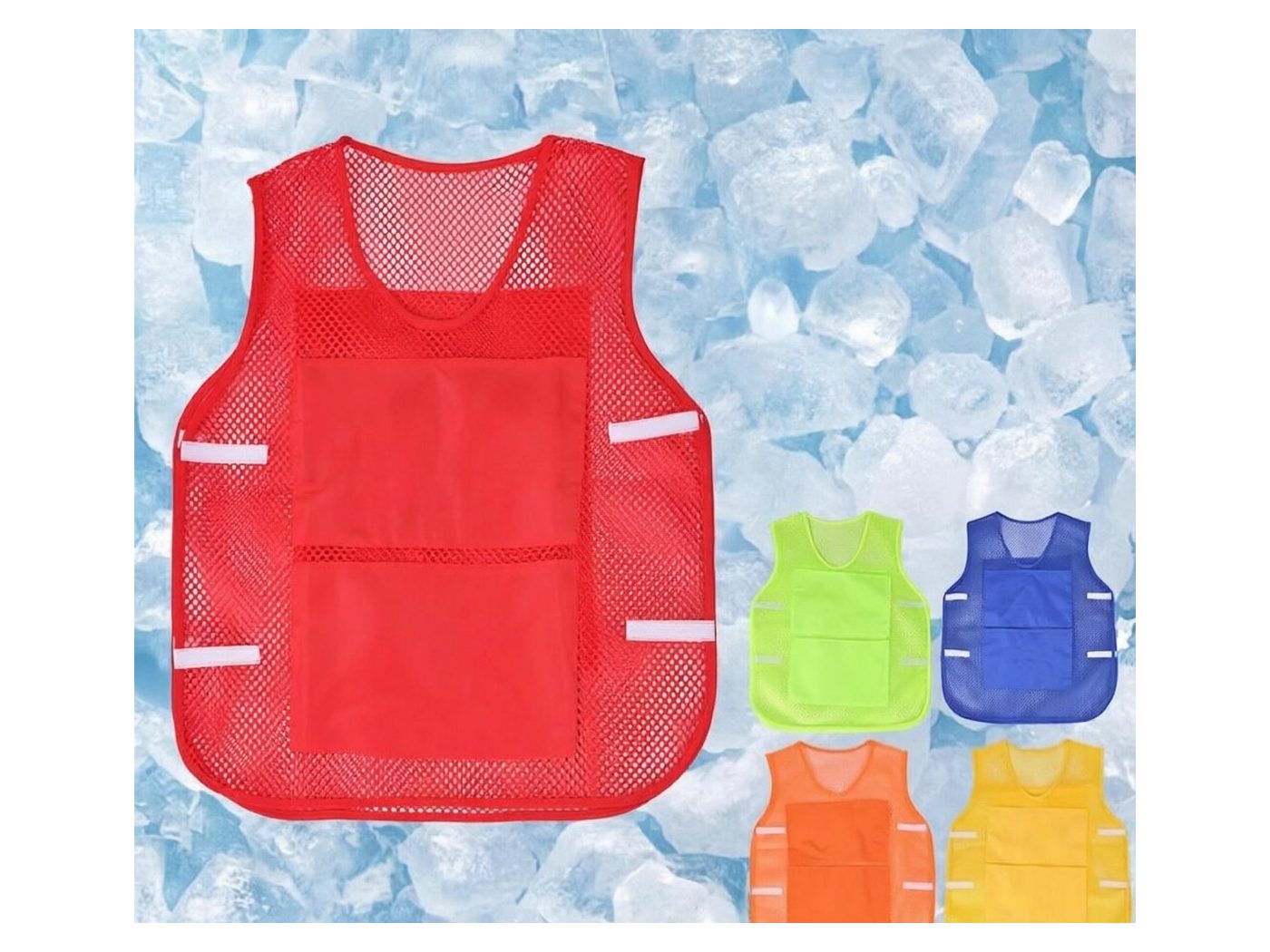
Standard pocket vest — 600D Oxford shell, sealed PEVA pack compartments, 3D air mesh lining. Shown loaded with 200 × 120 × 15 mm gel packs.
Why the pocket vest is the volume product
A frozen pack pressed against the torso does not need air movement to work. It moves heat out of the body by conduction, so it performs the same in a humid warehouse, a foundry aisle and a desert site. That single fact is why the pocket vest sells where pumped systems do not: there is nothing to charge, nothing to fill, and no pump to fail in the middle of a shift.
It is also the easiest cooling garment to deploy at scale. One size fits a wide range of wearers, the packs are a consumable reorder line, and the whole thing costs a fraction of an active system.
A vest is really a pack holder. Buyers who specify 24 packs can freeze half and wear half, then swap at the break — that is how you get a full shift of cooling out of a passive vest. We quote the pack count as a separate line item, because the packs are what get reordered every season.
Models
Six configurations covering the usual importer briefs: general site work, outdoor crews and full-shift rotation, plus two hi-vis versions for regulated sites where the vest also has to be the visibility garment.
| Model | Pockets | Packs | Shell | Lining | Cooling | Recharge | Notes |
|---|---|---|---|---|---|---|---|
| KS-C100 | 4 | 8 | Polyester mesh | — | 1 – 1.5 h | 4 – 6 h freezer | Entry level; retail, events and sports programmes |
| KS-C200 | 6 | 12 | 300D polyester | Polyester mesh | 1.5 – 2 h | 4 – 6 h freezer | General warehouse and site work |
| KS-C300 | 8 | 16 | 600D Oxford | 3D air mesh | 2 – 3 h | 4 – 6 h freezer | Workhorse for outdoor crews and fabrication |
| KS-C400 | 12 | 24 | 600D Oxford | 3D air mesh | 3 – 4 h | 4 – 6 h freezer | Full torso coverage; 24 packs allow half-and-half rotation |
| KS-H200 | 6 | 12 | Hi-vis polyester mesh + reflective tape | Polyester mesh | 1.5 – 2 h | 4 – 6 h freezer | EN ISO 20471 Class 2 / ANSI/ISEA 107 Type R Class 2 |
| KS-H300 | 8 | 16 | Hi-vis polyester mesh + reflective tape | 3D air mesh | 2 – 3 h | 4 – 6 h freezer | Hi-vis workhorse for regulated construction sites |
Fit and adjustability
Adjustable shoulder straps and side buckles, one size covering a wide fit range. Worn as an over-garment, so it sits over a hi-vis vest or a coverall without restricting shoulder and arm movement.
Pack specification
Standard 200 × 120 × 15 mm flat packs, or 200 × 120 × 35 mm high-capacity packs for longer shifts. Sealed PEVA compartments rated from −20 °C to 60 °C. Packs are quoted separately and are the reorder line.
Private label
Your logo on the shell, on the carry bag and on the hang tag, with a branded instruction card. Available from 500 pieces and included in the documentation pack.
Gel packs or PCM packs
Both fit the same pocket, but they behave differently enough that the right choice depends on the site. This is the single most common question we get on this product, so we answer it up front.
| Gel pack | PCM pack | |
|---|---|---|
| How it cools | Cold at first, warms steadily | Holds a set temperature while melting |
| Typical cooling | 1 – 2 h | 2 – 4 h |
| Recharge | 4 – 6 h in a freezer | 4 – 6 h freezer, or 15 – 30 min in cold water |
| Feels like | Very cold, then fading | Even and controlled |
| Best for | Short high-intensity exposure; crews with freezer access | Long shifts, humid sites, and wearers who find ice packs too intense |
Packs wear out, get lost and get left at the site. We quote them separately from the vest so your customer can reorder without re-ordering the whole garment — and we can consolidate a pack reorder with your next glove or sling order into one shipment.
What is actually certified
Here we would rather be precise than impressive. Cooling vests are handled differently by different markets, and a supplier who blurs this is a supplier whose paperwork will not survive your customer's audit.
- A standard pocket cooling vest is not, by itself, PPE. It is heat-stress mitigation clothing. There is no EN standard that certifies the cooling performance of a passive ice-pack vest, because no such performance is standardised.
- Hi-vis models are PPE. Where the vest is also the visibility garment, the certification that applies is EN ISO 20471 (EU) and ANSI/ISEA 107 (US), Class 1 or Class 2 depending on the risk level and the surface area of fluorescent and reflective material.
- Heat assessment happens at the site. Your customer assesses the workplace with ISO 7243 (WBGT) or ISO 7933 (PWB). Those decide whether cooling PPE is required at all — we are happy to supply the garment without pretending to certify the workplace.
- Pack material is documented separately. The ice pack film is food-grade LDPE, tested to FDA 21 CFR 177.1520 and EU 10/2011 food-contact rules, and does not crack at −30 °C.
- We will tell you which category your order falls into before you ship, rather than printing a standard number on the box.
A distributor selling cooling vests into European or American construction supply will eventually be asked to produce a Declaration of Conformity. If the garment was never PPE, the honest answer is a manufacturer declaration covering materials and instructions — not a CE mark borrowed from an unrelated standard. We supply the right document for the right product.
What arrives with the goods
- Specification sheet — shell fabric, lining, pocket construction, pack dimensions and count
- Material safety statement for the ice pack film, with the food-contact test reference
- EN ISO 20471 / ANSI/ISEA 107 test report for hi-vis models, with the class stated
- Declaration of Conformity or manufacturer declaration, matched to how the garment is actually sold in your market
- Cooling curve report — measured pack temperature over time, so the quoted duration has a document behind it
- User instructions covering freeze time, recharge, wear time, sizing and care, plus a care label
- Batch traceability and carton marks matching the packing list
Heat-related illness carries the same regulatory weight in most jurisdictions as a cut hand — in the UK it sits under the Management of Health and Safety at Work Regulations, with heat treated as a recognised hazard. For a distributor, the cooling vest is usually the easiest PPE line to specify and the easiest to demonstrate value, because a single wearer can feel the difference within minutes.
Cooling vests are usually bought alongside hard hats, hi-vis and gloves for the same crew. Because we already handle gloves, we can quote the personal protection package together and consolidate the shipment — fewer suppliers for your customer to chase, one container, one document pack.
Tell us the shift length and the climate.
Hours on site, typical ambient temperature, whether the wearer needs the vest over a hi-vis vest, and whether there is a freezer available for recharging. That is enough for us to recommend the right model and pack type — and to tell you honestly if the cheapest option will work.